

Vanity Table with Adjustable Mirror: A Practical Buying Guide

A mirror that moves isn’t automatically a better fit. A vanity table with adjustable mirror is most useful when you can position it comfortably for your routine and the table fits your available space. Before choosing, picture where you’ll sit or stand and how close you like to be to the mirror. The right setup makes getting ready feel easier, not more complicated.
It’s easy to focus on the mirror and overlook the details that shape everyday use. Can you reposition it from your usual seat? Will the table leave enough room to move around? Do the lighting and storage suit the way you get ready? Weigh these features separately so an appealing design also works in practice.
This guide explains what mirror adjustability can add, how adjustable and fixed mirror setups compare, and what to consider before choosing. You’ll also learn how to assess lighting, storage, and table dimensions so you can find an option that fits your room and routine.
Key Takeaways
- See how mirror movement can support different seated or standing routines, and why adjustability is separate from lighting or storage.
- Use a checklist to assess viewing angle, ease of repositioning, access, and stability before you buy.
- Compare adjustable, fixed, and separate tabletop mirrors to find a setup that suits your routine and available space.
- Measure the vanity’s footprint and allow comfortable access around it before weighing your must-have features.
- Explore the Stylish Vanity Table with Adjustable Mirror & 3 Color Lighting Modes, featuring an adjustable mirror and three color lighting modes.
Why Choose a Vanity Table with an Adjustable Mirror?
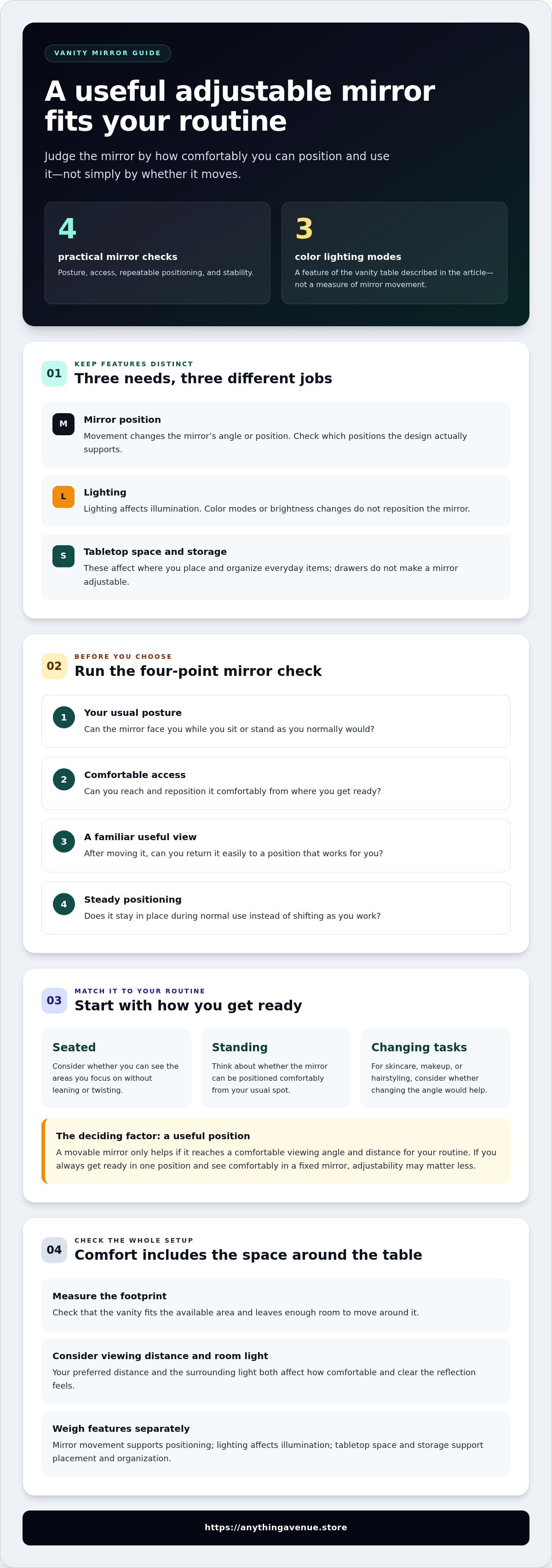
A vanity table with an adjustable mirror lets you change the mirror’s position or angle to suit how you’re getting ready. That movement is separate from lighting and storage: a mirror can adjust without offering different light settings, and lights or drawers don’t make a mirror adjustable. The feature is useful when it helps you see comfortably, not simply because it appears on a feature list.
The dressing table has changed over time, but the mirror has long been part of its appeal. For a little background on the history of vanity tables, you can explore how these pieces have evolved. Today, the practical question is more personal: does the mirror’s position work for your routine?
What does an adjustable mirror mean on a vanity table?
It means the mirror can be repositioned, whether by changing its angle or moving it into another position. Designs differ, so don’t assume every mirror tilts, swivels, or moves through the same range. Lighting is a separate feature: adjustable brightness or color modes change the light, not the mirror’s position. Check the listed movement and consider whether it suits the way you’ll use the table.
Who may benefit from a mirror that moves?
A mirror that moves may suit someone who alternates between sitting and standing or wants a different viewing angle for makeup, skincare, or hairstyling. Your posture and preferred distance from the mirror both matter. If you always get ready in one position and see comfortably in a fixed mirror, adjustability may be less important. Let your habits guide the decision.
Picture two routines. With a fixed mirror, you might lean forward or shift your chair to get a clearer view of a particular area. With a repositionable mirror, you may be able to change its angle instead and keep a more comfortable posture. The difference depends on the design and your setup. Movement won’t improve visibility if the mirror still can’t reach a useful position.
Before treating adjustability as a must-have, think through the moments when you’d use it:
- For seated routines: Consider whether you can see the areas you focus on without leaning or twisting.
- For standing routines: Think about whether the mirror can be positioned comfortably from your usual standing spot.
- For switching tasks: If you move between skincare, makeup, and hairstyling, consider whether changing the angle would make those routines easier.
Then picture your everyday setup, not an idealized one. Where do you sit or stand? How close do you like to be? The mirror’s movement is helpful only if it suits those preferences and stays useful in the position you choose. If you rarely change your viewing angle, a simpler fixed setup may serve you just as well.
How to Evaluate an Adjustable Mirror Before You Buy
A good mirror should do more than move: it should be comfortable to use, easy to reposition for your routine, and steady where you leave it. Before choosing a vanity table with adjustable mirror, assess how the mirror works as its own feature. Lighting, tabletop space, and storage matter too, but each answers a different need.
A useful adjustable mirror is one you can position comfortably, return to easily, and use without it shifting during your routine. Keep that standard in mind as you compare options. For more on how movable mirrors can support everyday care, explore the benefits of adjustable mirrors for personal care.
Does the mirror move in a way that suits your routine?
Picture where you’ll sit or stand and the view you need for the tasks you do most. Consider whether you can reach the mirror easily, reposition it without disrupting your setup, and return it to a useful position. A movement feature is practical only if it works naturally with your habits rather than making routine adjustments feel like extra effort.
- Try your usual posture: Think about whether the mirror can face you while you sit or stand as you normally would.
- Consider access: Check whether you can adjust it comfortably from where you’ll get ready.
- Look for repeatable positioning: Consider whether you can return the mirror to a familiar, useful view after moving it.
- Notice stability: The mirror should stay in position during normal use instead of shifting when you look closely or work at the table.
Designs vary, so don’t assume a product offers a particular movement range or adjustment method just because it’s described as adjustable. Focus on the positions it supports and whether those fit your needs. A mirror that’s awkward to move, hard to reach, or unsteady may offer little everyday benefit.
Can you see clearly and use the mirror comfortably?
Think about your preferred viewing distance and whether the mirror’s position lets you maintain a relaxed posture. Surrounding light also affects what you can see: a bright or dim room may change how clear the reflection feels. A movable mirror and a lighted mirror are separate features, so assess positioning and lighting independently rather than assuming one provides the other.
Keep the checklist focused. Mirror movement and stability affect how you view and use the reflection; lighting affects illumination, while tabletop space and storage affect where you place and organize your everyday items. Comparing those categories separately makes it easier to identify what will improve your setup.
Ready to compare a vanity option with both mirror movement and lighting? Explore Anything Avenue’s vanity table with an adjustable mirror and three color lighting modes.
Adjustable Mirror vs. Fixed Mirror: Which Vanity Setup Fits Better?
The right mirror setup depends on how you get ready and how much room you have. An adjustable mirror gives you the option to change its position, while a fixed mirror stays in one viewing position. A separate tabletop mirror can be placed independently, but it needs its own surface or mounting spot. Here’s how the options compare:
| Setup | Flexibility | Repositioning | Footprint | May suit |
|---|---|---|---|---|
| Adjustable mirror | Offers a choice of viewing positions, depending on the design | Moves as part of the vanity setup | Uses space as part of the table arrangement | Routines that shift between different postures or viewing angles |
| Fixed mirror | Stays in one position | Doesn’t move as part of everyday use | Integrated into the vanity setup | A consistent routine with a preferred viewing position |
| Separate tabletop mirror | Can be placed separately from the table’s mirror setup | Can be moved to another suitable surface | Needs a surface or separate mounting space | Anyone who wants to choose where the mirror sits |
When is an adjustable mirror more practical than a fixed one?
Consider an adjustable mirror if you sometimes change how you sit or stand, or prefer different views for different parts of your routine. Being able to reposition it may reduce the need to shift your own position. But movement varies by design, and extra flexibility may not add much if you always use the same angle and posture. Weigh that convenience against the space the full vanity setup occupies.
A fixed mirror can make sense if you’ve already found a comfortable viewing position and don’t expect to change it. Its simplicity may suit a straightforward routine and a room where you want a built-in arrangement. Neither choice is automatically clearer or more comfortable; your position, room layout, and preferences shape the result.
When might a separate mirror suit your setup?
A separate mirror offers more freedom over where you place it. You might prefer it on a different surface or want to move it between suitable spots rather than keep it attached to the vanity. That flexibility comes with a space trade-off: you’ll need a stable surface or a suitable place to mount it, as well as room for the mirror itself.
For a compact setup, an integrated mirror may keep the arrangement more contained. For a routine that changes or a room with another useful surface, a separate mirror may offer more choice. Think through where each option would sit and how you’d use it before deciding. A vanity table with adjustable mirror can be a practical middle ground if repositioning matters but you want the mirror as part of the table. The best fit is the one that suits your routine and room.
Match the Vanity Table to Your Space, Routine, and Must-Haves
A practical choice starts with your room, not a list of features. This process helps you narrow down a vanity table with adjustable mirror by checking fit first, then deciding which details will earn their place in your routine.
- Measure the available space. Note the width and depth of the spot where you plan to place the table. Allow room to sit or stand comfortably and move around it. Consider nearby furniture, walkways, and anything you’ll need to reach. The full footprint matters, not just whether the table can be squeezed into the space.
- Think through everyday access. Picture yourself getting ready in the intended spot. Will you have enough room to pull up a chair, stand comfortably, and reach the items you use? If furniture or a walkway sits close to the table, account for that before comparing options. A layout that works on paper should also feel comfortable to use.
- Compare the measurements with product details. Once you know your available footprint, compare it with the dimensions provided for each table. Check width and depth, along with any other listed measurements that affect placement. Don’t rely on appearance in a photo alone. If the table needs to sit near a wall or beside another piece of furniture, make sure the surrounding space still works.
- Match the mirror to your routine. Consider whether changing the mirror’s position would help with the way you get ready. If you tend to use the same posture and viewing position each day, adjustability may be less important. If your routine varies, give mirror movement more weight. Focus on how you’ll use the feature rather than choosing it simply because it’s available.
- Rank lighting and storage by daily importance. Decide separately how much lighting matters and how much storage you need. A table’s lighting features are distinct from mirror movement. For example, three color lighting modes offer a choice of light settings, while an adjustable mirror changes its position. Think about what you’ll use regularly, then prioritize the features that support those needs. Storage needs depend on how many items you want close at hand and how you prefer to organize them.
By the end, you should have two clear guides: a footprint the table must fit within and a short list of features in order of importance. That makes it easier to compare options without letting an attractive extra outweigh a practical need. If the mirror is your top priority, consider it alongside room fit and your preferred routine. If space is tight, keep your measurements and access needs at the center of the decision.
Ready to browse with your measurements and priorities in mind? Explore vanity tables at Anything Avenue and compare options for your space and routine.
Explore Anything Avenue's Vanity Table with Adjustable Mirror
After considering your room, routine, and feature priorities, compare a specific option against your checklist. Anything Avenue offers the Stylish Vanity Table with Adjustable Mirror & 3 Color Lighting Modes. Its features include an adjustable mirror and three color lighting modes. Weigh these separately: does mirror movement suit your preferred viewing position, and do the lighting modes fit what you want from your vanity setup?
What is confirmed about the Anything Avenue vanity table?
The product has an adjustable mirror and three color lighting modes. The mirror feature concerns positioning; the lighting modes are separate. Keeping those functions distinct can help you decide whether each matches your priorities instead of assuming one replaces the other. Review the product listing as you compare the table with your room and routine.
- Mirror movement: Consider whether an adjustable mirror is useful for the way you sit, stand, and get ready.
- Lighting: Decide whether three color lighting modes are a feature you value in your vanity setup.
- Room fit: Compare the product details with your available space and the measurements you took before browsing.
- Routine fit: Think about whether the listed features support the tasks you do regularly, rather than occasional wishes.
How to decide whether this vanity table suits your needs
Start with the space. Use your room measurements to assess the listed product information and consider how the table would fit alongside nearby furniture and your usual getting-ready spot. Then check your priorities one by one. If repositioning the mirror matters most, focus on that feature; if lighting matters too, consider it separately. A feature is valuable when it fits your real routine.
Imagine a typical day rather than judging the product by its name alone. Would you use the mirror’s adjustability regularly? Would the lighting modes be relevant to how you get ready? Do the product details give you the information you need to compare the table with your measurements and priorities? These questions keep the decision personal and practical without assuming every feature is essential for every shopper.
A vanity table with adjustable mirror may be a good match if the mirror feature aligns with your preferred setup and the listed details suit your space. Review the product information alongside your checklist before choosing. Ready to take a closer look? Browse the vanity table at Anything Avenue and review its product details.
Choose a Setup That Feels Right for Your Routine
Your vanity should support the way you like to get ready, not ask you to reshape your habits around it. As you make your choice, picture an ordinary morning: where you’ll sit or stand, what you’ll reach for, and how you want the space to feel. That everyday scene can be a better guide than a long list of extras. A vanity table with adjustable mirror is worth considering if changing the mirror’s position suits the way you use your space.
If you’d like to explore a specific option, Anything Avenue’s Stylish Vanity Table with Adjustable Mirror & 3 Color Lighting Modes combines an adjustable mirror with three color lighting modes. Review the product details alongside your needs, then decide whether it fits your room and routine.
Explore the Stylish Vanity Table with Adjustable Mirror & 3 Color Lighting Modes and find out whether it suits your getting-ready space.
Frequently Asked Questions
Is an adjustable mirror useful on a vanity table?
It can be useful if changing the mirror’s position helps you see comfortably during tasks you do often. For example, you might prefer one view for applying makeup and another for checking your overall look before heading out. If you’re happy with a single viewing position, the extra movement may not add much. Think about when you’d actually adjust it, not just the feature name.
Can you adjust a vanity mirror while seated?
That depends on the mirror’s design and where it sits. Imagine sitting at the table and reaching the mirror without standing or leaning awkwardly. Consider whether your chair can sit comfortably in place and whether the mirror can reach a useful position from there. If you can try the setup in person, test it from your usual seated posture rather than adjusting it while standing.
Do all vanity tables with adjustable mirrors include lights?
No. Mirror movement and lighting are separate features, so an adjustable mirror doesn’t automatically mean the table has lights. Check the product description for lighting details rather than inferring them from the mirror feature. If you get ready in a room with limited natural light, consider how the space is lit and whether you want a table with lighting or prefer to use the room’s existing light.
How do you clean a vanity mirror without streaks?
Start with a clean, soft microfiber cloth and remove loose dust before wiping the glass. If you use glass cleaner, apply it to the cloth rather than spraying directly onto the mirror, which can help prevent liquid from reaching the frame or nearby surfaces. Wipe in overlapping strokes, then buff gently with a dry part of the cloth. Follow any care instructions provided for the specific mirror.
What should you place on a vanity table?
Keep the surface useful by placing only the items you reach for regularly, such as a hairbrush, skincare essentials, or everyday makeup. A small tray can group compact items so they’re easier to pick up and put back. Leave a clear area for your routine rather than covering the whole tabletop. Less-used products can live elsewhere, keeping the things you need close without crowding your workspace.
Can a vanity table with an adjustable mirror work in a small room?
Yes, if the table’s footprint fits and there’s enough room to use it comfortably. Measure the available width and depth, then consider nearby doors, furniture, and the space needed for your chair or standing position. Compare those measurements with the product details before deciding. In a particularly tight spot, a separate tabletop mirror may offer another setup option, provided you have a suitable surface for it.