

How to Choose a Vanity Table: A Practical 2026 Guide

What if the best-looking vanity table is the wrong one for your room? The right choice starts with your space and routine, not just a style you love. If you’re wondering how to choose a vanity table, consider where it will fit, what you’ll use it for, and how much storage you need.
It’s easy to get caught between a compact design that saves space, a larger table with room for everything, and a polished look that feels like you. A room-first checklist makes the decision easier. Measure the available area and plan for a seat, then match the table’s storage, mirror, and lighting to your daily routine. Finally, compare finishes and features that suit your room without adding details you won’t use. If an adjustable mirror and lighting options matter to you, the Stylish Vanity Table with Adjustable Mirror & 3 Color Lighting Modes is one option to consider. By the end, you’ll have a clearer idea of what fits, what’s useful, and what feels right for your space.
Key Takeaways
- Start with the tasks you do each day so your vanity supports your routine, not just your room’s style.
- Measure the intended footprint and note obstacles, door and drawer clearances, and walkway space before comparing options.
- Compare open-surface, drawer-focused, compact, and multipurpose layouts by how they fit your space and keep everyday items accessible.
- When considering how to choose a vanity table, weigh mirror position, lighting, surface comfort, and access to frequently used items.
- Use a final checklist of routine, measurements, layout, storage, and useful details to rule out options that won’t fit or serve you well.
How to Choose a Vanity Table by Starting with Your Daily Routine
A vanity table is a surface, often paired with a mirror, where you can get ready and keep everyday grooming essentials close at hand. It can also make a bedroom routine feel more settled and personal. For a little background on how this furniture has evolved, explore the History of Vanity Tables.
Before comparing finishes or silhouettes, write down what you actually do at your vanity. This routine-first step is central to choosing a table that earns its place in your bedroom. Separate everyday tasks from occasional ones, then note which items need to be within easy reach. A table should support your habits, not tempt you to choose features for a routine you rarely have.
Which tasks will your vanity table support?
Think through a typical morning or evening. Do you use the space for grooming, applying makeup, styling your hair, or gathering daily essentials before heading out? Be specific: a quick daily routine calls for a different setup than one involving several tools and products.
- Used daily: List the items you reach for often and keep them accessible.
- Used occasionally: Note special-occasion products or tools that can live in a drawer or elsewhere.
- Kept on the surface: Record what you want visible and easy to reach.
Frequency matters. If you use an item every morning, having to unpack it from a crowded drawer can make the setup less convenient. Occasional-use items don’t need prime tabletop space. Your list helps you picture the surface you need and what can be stored away, keeping the station useful instead of overloaded.
A good fit supports your routine, feels comfortable to use, and suits the room you have.
When should a vanity table serve more than one purpose?
A vanity might also work as a writing spot, a place to sort accessories, or a small bedroom workspace. Ask whether you’ll genuinely use that second function or whether it simply sounds appealing while you’re shopping. If another task is part of your regular routine, include it in your notes before comparing table layouts.
Shared use works best when you can clear the surface easily and sit or stand comfortably for both activities. For example, if you plan to write there, consider whether your everyday grooming items would need to move first. If so, decide where those items will go so the table can switch roles without a lot of rearranging.
Keep the main routine in charge. A secondary function should add flexibility, not crowd out what you use most. If getting ready is the priority, choose around that first and treat any extra use as a bonus. This keeps your shortlist focused on features that support real habits rather than a wish list that leaves the table underused.
Measure Your Bedroom Before Choosing a Vanity Table
A vanity can look compact online and feel surprisingly bulky once it’s in place. Before comparing options, measure the spot you have in mind and the room around it. This gives you a practical fit check instead of a guess based on a photo.
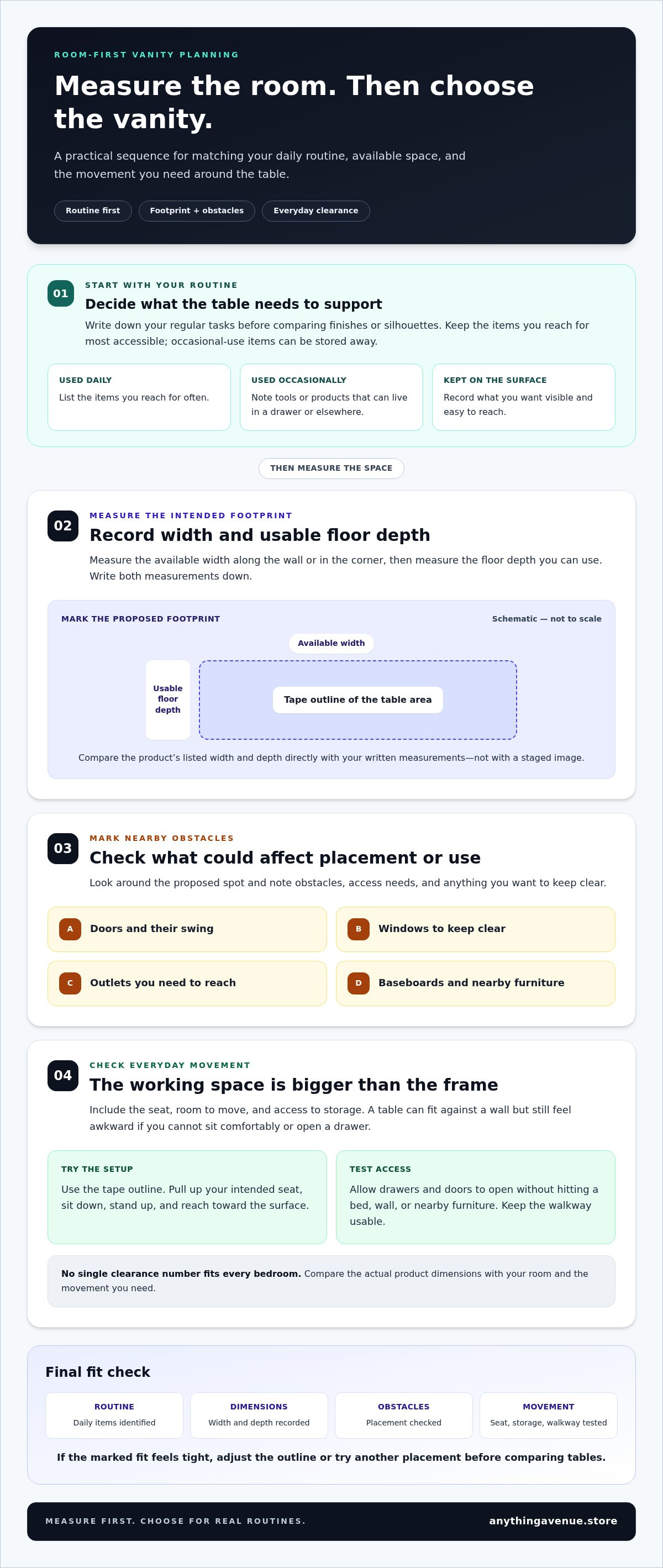
Follow these steps in order:
- Measure the intended footprint. Record the available width along the wall or in the corner, then measure the usable floor depth. Write down both measurements, even if the area looks straightforward.
- Mark nearby obstacles. Check for doors, windows, outlets, baseboards, and furniture that could affect placement or use. Include the swing of nearby doors.
- Check movement space. Account for the room you’ll need to sit down, stand up, reach the tabletop, and open any drawers or doors. Keep the walkway usable, too.
The table’s footprint is only the space its frame occupies. Your working space is larger: it includes the chair or stool, room to move while using the table, and access to storage. A design may fit against the wall but still feel awkward if you can’t sit comfortably or pull a drawer open.
What should you measure around the table?
Measure the full available wall or corner width and the floor depth you can use without blocking a route through the bedroom. Note anything that could affect placement, such as a window you want to keep clear, an outlet you need to reach, or a nearby bedside table. Use removable tape to mark the proposed footprint on the floor. This makes it easier to see whether the size feels balanced before you decide.
Write the width and depth together so they’re easy to compare with product dimensions. If a listing gives the table’s width and depth, compare those measurements directly with your marked area. Don’t rely on a staged image or visual estimate. Camera angles and room proportions can make furniture look smaller or larger than it is.
How can you check everyday clearance?
Stand in the marked area and mimic how you’ll use the table. Pull up the seat you plan to use, sit down, stand, and reach toward the surface. If the table has drawers or doors, allow them to open without hitting a bed, wall, or nearby furniture. Check that you can still move through the room without squeezing past the seat.
There’s no single clearance number that suits every bedroom or furniture layout. Compare the actual product dimensions with your room and the movement you need. If the fit looks tight, adjust the tape outline or try another placement before shopping.
Once your measurements are written down, you can browse vanity table options with a clearer sense of what your bedroom can accommodate.
Compare Vanity Table Layouts, Storage, and Everyday Usability
Once you know the available space and the tasks your table needs to support, compare layouts by how they balance tabletop room and storage. More drawers aren’t automatically better. Extra capacity only helps if it holds things you actually use; otherwise, it can take up room without making your routine easier.
Layout determines how storage and usable surface share space. Use this comparison to identify the trade-offs that matter for your bedroom and daily habits.
| Layout | Footprint | Accessible storage | Often suits |
|---|---|---|---|
| Open-surface | Varies, with more of the top available | Limited or separate from the tabletop | Routines that need clear working space and only a few items close by |
| Drawer-focused | Varies with the amount of built-in storage | Items can be tucked away, with frequently used pieces kept in the top drawers | Routines with several everyday products or tools to organize |
| Compact | Designed to occupy less room | May be limited, so choose what stays close carefully | Smaller rooms or routines with a short list of essentials |
| Multipurpose | Depends on its additional use and setup | Storage needs to work alongside other bedroom tasks | People who want one surface to support grooming and another regular activity |
These are broad layout patterns, not fixed size categories. Compare each option with your measurements and the room it needs for use. The best match keeps your routine practical without crowding the bedroom.
Which layout suits your room shape?
A compact footprint may make sense if the available area is limited or the table needs to share space with other furniture. A corner-oriented or wall-oriented design may also work, but only if it fits the spot you measured and leaves the room comfortable to move through. Don’t assume a layout will work just because it’s marketed as space-saving; compare its actual dimensions with your room.
How much storage and surface space do you need?
Count the items you use and group them by frequency: daily, occasional, and rarely. That simple sort is a better guide than choosing the table with the most drawers. Keep daily essentials easy to reach, while occasional-use items can go into drawers or be stored elsewhere.
An open surface makes visible items quick to grab, but it can look crowded if too much has to stay out. Drawers or enclosed storage can clear the top, though items tucked away may take an extra step to access. Consider the balance that suits your routine: space for the items you use at once, plus enough storage to put the rest away.
Picture your everyday items on the tabletop and in storage before you decide. If the layout leaves no clear working area, or offers storage you don’t need at the expense of useful surface space, cross it off. This makes choosing a vanity table less like guesswork and more like finding a practical match.
Choose Vanity Table Details That Make Getting Ready Easier
Once the layout feels right, look closely at the details you’ll interact with every day. A mirror that’s awkward to position, lighting that doesn’t suit the room, or essentials tucked out of reach can make a promising setup inconvenient. Check each feature against your routine, not just its appearance.
Use this checklist as you compare options:
- Mirror usability: Does its position work for the tasks you do most often? Could an adjustable angle help?
- Lighting approach: Consider the room’s existing light and whether task lighting would be useful for your routine.
- Surface comfort: Is there enough clear space to use your usual items without feeling crowded?
- Easy access: Can you reach frequently used products and tools without moving other things first?
These practical details are an important part of choosing a vanity table you’ll enjoy using. A feature is useful when it fits your space and makes your regular routine simpler.
What should you look for in a vanity mirror?
Start with the way you get ready. Consider whether you need a clear view for grooming, makeup, or another regular task, and whether the mirror’s position works with how you sit or stand. An adjustable mirror lets you change the viewing angle to suit different tasks. Think about where the table will sit in the bedroom, too, so the mirror feels practical in that spot.
Compare the mirror’s position with the tasks you listed earlier. If you move between sitting and standing, consider whether you can adjust the angle easily. If you tend to keep the table against a wall, make sure the mirror still gives you a comfortable view from your usual seat.
How should you think about vanity lighting?
Notice how natural and room lighting reach the area at the time you usually get ready. Then consider whether a separate task light or a vanity with lighting better suits your setup. Keep the choice tied to your routine and room, rather than assuming one arrangement works for everyone.
The Stylish Vanity Table with Adjustable Mirror & 3 Color Lighting Modes is an option if an adjustable mirror and three lighting modes are features you value. Compare those features with the light already available in your room and how you use the table.
Before you decide, picture using the table at your usual time of day. Check that the mirror position feels workable, the lighting approach makes sense for the room, and your everyday essentials are easy to reach. For an option with an adjustable mirror and three color lighting modes, explore the vanity table at Anything Avenue.
Use a Final Checklist to Choose a Vanity Table with Confidence
You’ve considered your routine, room, layout, storage, and useful details. Now bring those decisions together. The best option isn’t necessarily the one with the most features or the boldest look. It’s the one that fits your space and supports the tasks you’ll actually do there.
Use this five-step checklist to make your final comparison:
- Routine: Identify the main tasks the table needs to support, and keep your regular habits at the top of the list.
- Measurements: Compare the table’s width and depth with your recorded space, including room to sit, move, and open storage.
- Layout: Choose an arrangement that suits the bedroom and leaves enough usable surface for your routine.
- Storage: Make sure the drawers or open storage suit the items you use, rather than adding capacity you don’t need.
- Useful details: Check that mirror position, lighting approach, and access to everyday essentials work for you.
Treat the first two checks as must-haves. If an option doesn’t fit the marked area or leaves too little room to use it comfortably, cross it off, even if its style is appealing. Then compare the remaining tables by how well their layout and features match your routine. This keeps the decision personal and practical.
What are the most common vanity table selection mistakes?
Choosing by appearance alone is an easy trap. A table can suit your bedroom style and still block a walkway, interfere with a nearby door, or leave no comfortable place to sit. Compare its product dimensions with your measurements and marked floor footprint, not with how spacious it looks in a photo.
It’s also easy to assume extra drawers or features will make a table more useful. Storage you don’t need can take up space, and extra features won’t improve a routine they don’t serve. Revisit your list of daily tasks and essentials to separate real needs from nice-to-haves.
How can you make the final choice?
Before settling on an option, make one last pass: does it fit the measured spot, work for your main routine, and offer details you’ll actually use? If yes, you’ve narrowed the choice for clear reasons, not just a first impression. If not, return to the checklist and remove any option that misses a room-fit or daily-use requirement.
If an adjustable mirror and three color lighting modes are features you value, consider the Stylish Vanity Table with Adjustable Mirror & 3 Color Lighting Modes. Explore the vanity table online and compare its features with your checklist.
Make Your Vanity Feel Like Yours
The right vanity can become a small, welcoming part of your day, a place that feels ready when you are. Let the priorities you identified guide your choice, and put comfort and usefulness ahead of features that simply look appealing. That’s the heart of how to choose a vanity table: find one that feels at home in your room and makes your routine your own.
If an adjustable mirror and three color lighting modes are on your wish list, the Stylish Vanity Table with Adjustable Mirror & 3 Color Lighting Modes is worth considering. Picture it in your space and decide whether its features suit the way you get ready.
Explore the Stylish Vanity Table with Adjustable Mirror & 3 Color Lighting Modes and take the next step toward a bedroom setup that feels practical, personal, and inviting.
Frequently Asked Questions
What is the difference between a vanity table and a vanity desk?
The terms are often used interchangeably, though “vanity table” usually emphasizes grooming, while “vanity desk” can suggest a work surface with more than one purpose. A table with a mirror and space for cosmetics may suit a getting-ready routine; a desk-style surface may be easier to use for writing too. Descriptions vary, so focus on the layout and features rather than the label alone.
Can a vanity table be placed in a room without a window?
Yes, a window isn’t essential. In a room without one, consider the artificial lighting already available and whether a separate task light would suit your routine. Try the setup at the time you usually get ready, since evening lighting may feel different from daytime light. A mirror’s position and any built-in lighting can also affect how comfortable the spot feels.
Should a vanity table be secured to the wall?
Not every vanity table needs wall attachment, but stability matters. Check the product’s assembly and safety instructions, especially if the table is tall, narrow, or could be pulled or climbed on. If securing it is recommended, use the appropriate attachment for the wall and follow the supplied directions. In a home with young children or active pets, consider the risk of tipping before choosing where to place it.
What type of chair works with a vanity table?
Choose a seat that lets you sit comfortably at the tabletop and get close enough to use the mirror. Before buying, consider its height and width, and whether it can tuck under the table when you’re done. A stool can be handy if you want to slide the seat out of sight, while a chair with a back may feel more supportive during a longer routine. Make sure it doesn’t obstruct nearby movement.
How do you keep a vanity table organized between uses?
Give everyday items a simple home so they’re easy to put away after each use. A small tray can group frequently used products, while less-used items can be stored separately to keep the surface ready for your next routine. Return items after use and clear away packaging or empty containers as they accumulate. This quick reset helps prevent small items from spreading across the tabletop.
Can a vanity table work in a shared bedroom?
Yes, it can work in a shared bedroom if its placement and use feel considerate to both people. Agree on what can stay out, what should be stored, and when the surface is available. For instance, a personal organizer or tray can keep one person’s essentials together and make it easier to clear the area afterward. A shared setup works best when it doesn’t block access to the other person’s belongings.
How do you clean and care for a vanity table?
Follow the care instructions for the table’s specific finish, since suitable cleaning methods vary. As a gentle starting point, dust with a soft cloth and deal with spills promptly. Avoid abrasive pads or strong cleaners unless the care guidance says they’re suitable, as they may damage some surfaces. Keep liquids in closed containers where practical, and take care around mirror edges and any lighting components.